

There is a library that governments burned, scholars ignored, and practitioners passed hand-to-hand in manuscript for a thousand years. It is the Arabic occult tradition — the great corpus of sihr, ruhaniyat, jinn conjuration, and Solomonic theurgy that shaped Islamic mysticism, fed the Latin Picatrix, and quietly seeded half of Western ceremonial magic. For most of that millennium, you could not read it in English. You still cannot read most of it. But something significant is happening right now: a scholar named John Friend is opening that library, one volume at a time, and what is inside is extraordinary.
The Arabic Islamicate Occult Manuscripts series, published by John Friend Publishing, currently spans seven volumes — each a first complete English translation of a medieval Arabic grimoire that has never before been rendered into the language. These are not excerpts. They are not abridgements or paraphrases. They are faithful, unabridged scholarly translations with original Arabic script, proper ALA-LC transliterations, and every talismanic seal reproduced exactly as it appears in the source manuscript. For anyone serious about the history of magic, the Solomonic tradition, or the deeper roots of Western esotericism, this series is one of the most significant publishing events of the decade.
"For the practitioner, the historian, and the curious — this is the source material Western occultism has been quietly borrowing from for eight hundred years, now finally available to read in full."
What follows is an editorial review of all seven volumes currently in the series — what each book contains, why it matters, and who it is for.
Eight Centuries in Manuscript
Before diving into the individual volumes, it helps to understand what the Arabic occult tradition actually is — because it is not a peripheral or marginal phenomenon. This is one of the most intellectually sophisticated magical traditions in human history, produced in the great centers of Islamic learning between the 9th and 17th centuries: Cairo, Baghdad, Damascus, Fez, and Cordoba. It drew on Neoplatonism, Hermeticism, Babylonian astrology, Jewish Kabbalah, Indian stellar magic, and Quranic mysticism and fused them into an operational system of extraordinary coherence.
The tradition's central figure is Ahmad ibn Ali al-Buni (d. 1225 CE), whose Shams al-Ma'arif al-Kubra — "The Great Sun of Knowledge" — is the most influential Islamic occult work ever written. Around al-Buni's foundational text a vast literature grew: grimoires of planetary hours and jinn conjuration, manuscripts of Solomonic spirit-binding, treatises on magic squares (awfaq) and letter mysticism (ilm al-huruf), and practical manuals of love magic, protection, and divination. Most of this literature has never been translated into English. Until now.
Connection to the Picatrix
The famous Latin Picatrix is itself a translation of the 11th-century Arabic Ghayat al-Hakim. The same astral-magic logic runs through al-Jawahir al-Lamma'a and Shams al-Anwar — in the original language.
Connection to the Goetia
The Lesser Key of Solomon descends from Arabic and Hebrew prototypes. Kitab al-Ajnas and Sihr Muluk al-Jann are the Arabic Solomonic source-stream that the Lemegeton grew from.
The al-Buni Lineage
Al-Buni systematized divine names, magic squares, planetary spirits, and letter mysticism. Shams al-Anwar by Ibn al-Hajj al-Tilmsani (1327 CE) belongs to this exact same operational lineage.
Solomonic Theurgy
Prophet Sulayman (Solomon) is the supreme magician-king of the Abrahamic world. Kitab al-Ajnas, attributed to Sulayman's own vizier Asif ibn Barkhiya, is the source-text — not a descendant.
The Library, Reviewed

The series opens with its most accessible entry — a medieval Arabic text of folk astronomy and prophetic divination attributed to Daniel the Prophet. It is the least operationally dense of the seven volumes but in some ways the most revealing, because it shows the cosmological scaffolding that underlies everything else in the tradition: zodiacal astrology, Abjad calendrical calculation (the system of assigning numerical values to Arabic letters), and celestial prognostication as a form of divine interpretation.
The woodcut illustrations of the twelve zodiac signs reproduced here are genuinely striking — the visual language of medieval Islamic astronomy is not what most Western readers expect, and seeing Daniel's text illustrated in its original idiom is a jarring, productive reminder that this tradition developed independently of the European one. For tarot readers and astrologers approaching this series, this is the volume to begin with: it establishes the cosmological common ground between the Arabic tradition and the astrological thinking you already know, while making clear how differently that common ground was organized.

This is the volume that will stop readers cold — because it should not exist. Mujarrabat al-Ruhban is a medieval Arabic grimoire attributed to Christian monks versed in the esoteric sciences. Not Islamic scholars. Not Jewish Kabbalists. Christian monks, writing in Arabic, producing a syncretic magical manual that draws on Quranic talismans, Christian prayer, and operative spirit-conjuration within a single coherent system. The manuscript is an artifact of the remarkable intellectual porousness of the medieval Mediterranean world, where religious boundaries dissolved at the operational level of magic.
At 308 pages this is a substantial working manual — love and attraction magic (jalb, tahbib), protective amulets and Quranic talismans, reconciliation formulas, and spirit invocations for practical ends. The "tested formulas" (mujarrabat) of the title mean exactly that: these are recipes that claimed to have been tried and verified, not speculative theory. The number squares and geometric seals reproduced throughout are beautiful objects in themselves. For practitioners interested in the deep history of syncretic magic, this is one of the most important texts in the series.
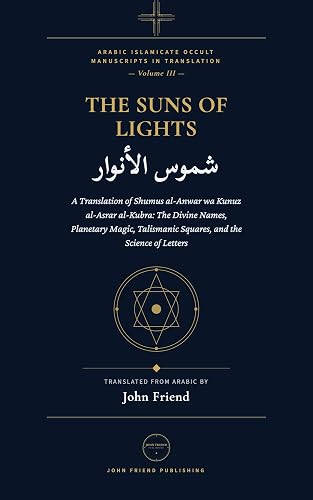
This is the cornerstone of the series. Written in 1327 CE by Ibn al-Hajj al-Tilmsani, a foundational figure in the Islamicate occult tradition, Shams al-Anwar has spent seven hundred years inaccessible to English readers. It belongs to the same direct lineage as al-Buni's Shams al-Ma'arif — the tradition's foundational text — and operates with the same machinery: the 99 Beautiful Names of God (al-Asma al-Husna) analyzed for their numerical values, planetary correspondences, and talismanic applications; magic squares (awfaq) from the 3×3 to the 7×7 planetary; the seven planetary spirits with their incenses, timings, and conjuration protocols; and the deep science of Arabic letter mysticism.
What makes this volume remarkable beyond its historical significance is its practical coherence. This is not speculative philosophy — it is an operational system, and a sophisticated one. The relationship between divine names, Abjad numerology, magic squares, and planetary timing is presented as a unified science, each element reinforcing the others. Anyone who has worked with the Western ceremonial tradition will recognize the underlying logic: astrology as spiritual grammar, divine names as operational keys, geometric seals as crystallized intention. But here it is in the original language and conceptual frame, seven centuries before the European occult revival attempted to reconstruct it from Latin fragments.
What It Means to Be First
The phrase "first complete English translation" appears on each volume in this series, and it is easy to read past it. It should not be. These texts are not obscure footnotes — they are the source tradition of a significant portion of Western occultism, the same texts the Latin Picatrix translated, the same logic the Lesser Key of Solomon borrowed. They have been in Arabic manuscripts for centuries, studied by Arabists and historians of religion, occasionally excerpted and discussed. But never translated in full. The gap between knowing a text exists and being able to read it is enormous. These translations close that gap.

At 362 pages and priced accordingly, Kitab al-Ajnas is the series' most substantial single volume — and arguably its most historically significant. The Book of the Races is attributed to Asif ibn Barkhiya, the legendary vizier and chief minister of the Prophet Sulayman (Solomon), the figure who in Quranic tradition transported the throne of the Queen of Sheba across continents in the blink of an eye. Whatever the historical reality of that attribution, it places this text at the absolute root of the Solomonic magical tradition — not a descendant of Solomon's system but, in its own mythological frame, the original.
The content lives up to its pedigree. This is a comprehensive grimoire of spirit taxonomy and conjuration — the "races" of the title referring to the various orders and kinds of jinn, spirits, and entities within the Solomonic cosmology, each with their characteristics, their names of power, their seals, and the specific protocols required to address them. The voces magicae — the words of power preserved across centuries of manuscript transmission — are reproduced exactly, with no substitution or sanitization. The talismanic seals are reproduced from the source. For any reader of the Goetia or Lemegeton, reading Kitab al-Ajnas is the experience of finding the room that all those Western ceremonial texts were drawing maps of.

Al-Jawahir al-Lamma'a is where the series' astrological and operational threads converge. This is a grimoire of planetary hours and jinn-king conjuration — a practical manual for summoning the seven kings of jinn at precisely the correct astrological moment, using the timing science that underlies every working in the tradition. The connection to the Latin Picatrix is explicit: the same astral-magic framework, the same insistence on planetary hours and correspondences, the same understanding that a magical operation performed at the wrong astrological moment is not merely ineffective but actively counterproductive.
What distinguishes al-Jawahir from the Picatrix — beyond being in the original language of the tradition rather than a Latin translation of an Arabic text — is its specificity about the jinn kings themselves. Each of the seven kings is addressed individually, with their specific seals, their divine names, their planetary and stellar correspondences, and the complete operational instructions for their conjuration. This is not theory. This is a working manual, and it reads as one. Astrologers and practitioners working with planetary magic will find this the most immediately applicable volume in the series.

Of all the volumes in the series, Tumtum al-Hindi has perhaps the most fascinating origin story. Attributed to a legendary Indian sage whose esoteric knowledge entered the Islamic magical corpus — the precise historical figure behind "Tumtum" remains a matter of scholarly debate — this grimoire represents the Indian strand of the Arabic occult synthesis. The Arabic magical tradition was never monolithic or self-contained; it absorbed and transformed stellar magic from Indian astronomy, astrological theory from Babylonian and Hellenistic sources, and practical magic from across the Afro-Eurasian world. Tumtum al-Hindi is that synthesis made visible.
The content centers on stellar magic through the 28 lunar mansions (manazil al-qamar) — a sophisticated system of timing and correspondence based on the moon's position among the fixed stars — alongside a substantial corpus of attraction, excitation, and love magic (jalb, tahyij, tahbib). At 298 pages this is a rich and operationally detailed text, with talismanic constructions for each purpose and the timing science required to activate them. For anyone interested in the Indian contributions to Islamicate occultism, or in the deep history of lunar-mansion-based magic, this is the volume to prioritize.
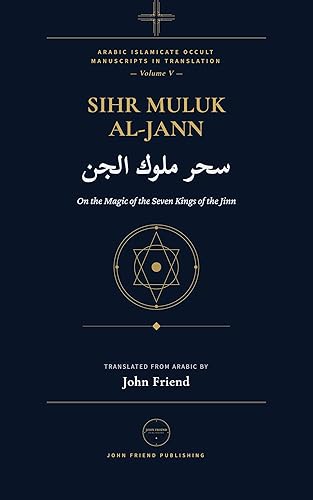
The seventh volume brings the series full circle — from the folk astrology of the Prophet Daniel to a comprehensive operational manual for the conjuration of the seven kings of the jinn within the Solomonic tradition. Sihr Muluk al-Jann is exactly what it says: the complete magic of the jinn kings, presented as a working practitioner's manual with specific seals, divine names, adjurations, and the behavioral and purification protocols required of the operator before, during, and after each working.
What is striking about this text, read alongside Kitab al-Ajnas and al-Jawahir al-Lamma'a, is how consistent and internally coherent the Arabic Solomonic tradition is across different texts and centuries. The same seven jinn kings appear across multiple grimoires with the same names, the same planetary attributions, the same fundamental logic of conjuration — suggesting a genuine living tradition with real continuity of practice, not a literary fiction. Sihr Muluk al-Jann is the most operationally focused of the three jinn-conjuration volumes, and for practitioners the most directly applicable. It is also a fitting capstone to a series that has, volume by volume, assembled the machinery of a complete magical system from its foundational texts.
A Library Worth Having
Taken together, the Arabic Islamicate Occult Manuscripts series by John Friend Publishing is a genuinely rare event in the history of esoteric publishing: primary source texts, faithfully translated, with scholarly apparatus intact, available to any reader who can afford a Kindle. The tradition these books represent is not exotic or peripheral — it is the source-stream of a significant portion of Western occultism, the root system that the Picatrix translated, that the Solomonic cycle borrowed from, that the entire planetary-magic tradition of the Renaissance was working with at second or third hand. Now it is available in the first hand.
The translation quality is consistent across all seven volumes — scholarly in apparatus, readable in prose. Friend does not over-modernize or paraphrase; the texts retain their medieval register without becoming incomprehensible. The preservation of original Arabic alongside English, with proper ALA-LC transliteration, means the volumes are genuinely useful for scholars and researchers, not just lay readers. And the reproduction of talismanic seals and magic squares from source manuscripts — rather than redrawn or regularized — matters enormously for anyone who wants to understand these objects as the tradition understood them.
If you approach this as a practitioner, begin with Volume I (Kitab Danyal) for the cosmological framing, Volume III (Shams al-Anwar) for the operative core, and either Volume IV (Kitab al-Ajnas) or Volume VII (Sihr Muluk al-Jann) depending on whether your interest runs toward Solomonic taxonomy or practical conjuration. If you approach this as a historian or scholar, the whole series is a primary source archive of the first order. If you approach this as someone who loves the occult, finds tarot and astrology and the hidden sciences genuinely meaningful, and wants to know where all of this actually came from — read them all. The library is finally open.
Browse the Full Library
Seven volumes in print now. More translations in active production.
View All Seven Volumes →


